

 EN
EN


Lawn care is no longer limited to traditional, flat terrain. With the growing demand for slope maintenance and managing hazardous landscapes, professionals and businesses are turning to innovative solutions. Among these solutions, remote control lawn mowers have gained significant traction. This technology provides a high level of safety, efficiency, and precision—especially in environments where conventional lawn equipment may pose risks to operators.
For B2B buyers in industries such as construction, infrastructure, agriculture, and renewable energy, investing in remote control mowers represents a game-changing shift. This article will explore the capabilities, benefits, and applications of remote control mowers, particularly in hazardous and steep terrains.
Safety is a top priority for industries dealing with steep slopes and challenging terrains. Remote control lawn mowers are designed to keep operators at a safe distance from the machine, eliminating the risk of injury in hazardous areas. For example:
Slope management: Operators can control the mower from the bottom or top of a steep slope, ensuring that they are not at risk of rolling over or slipping.
Dangerous vegetation areas: These mowers are perfect for handling dense underbrush or tall grass in remote and unsafe areas, such as along highways or power lines, reducing the risk of electrical shocks or other accidents.
This level of safety is essential for landscaping contractors, government agencies, and infrastructure maintenance teams that frequently work in high-risk environments.
Remote control mowers also excel in terms of efficiency. When dealing with extensive terrains like embankments, dam slopes, or steep embankments around construction sites, remote control mowers allow for quicker, more precise work. These systems enable operators to:
Cover larger areas in less time compared to traditional equipment
Minimize human labor required for vegetation maintenance in hard-to-reach places
Avoid costly equipment damage, which can occur if an operator loses control in difficult conditions
In environments where every minute counts, this improved efficiency translates into higher productivity, allowing contractors and service providers to complete more jobs in less time.
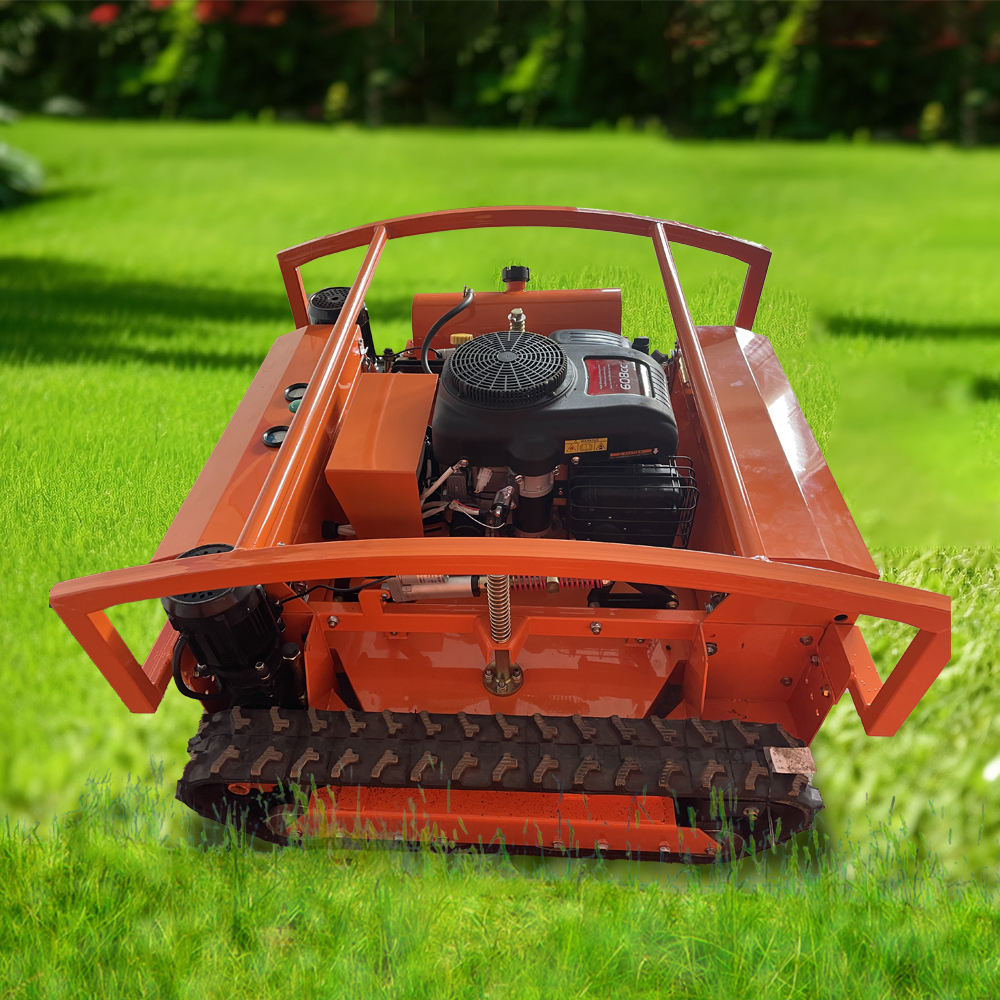
Remote control mowers are typically equipped with tracked drive systems, which provide excellent traction on uneven surfaces. Unlike wheeled machines, tracks ensure that the mower stays grounded even on 45-degree slopes or rough, rocky terrains. The low center of gravity ensures stability, while the high-torque drive systems guarantee effective cutting, even in tough vegetation.
This makes them ideal for applications in solar farms, dam slopes, and hilly agricultural fields, where other equipment might struggle to perform effectively.
The operator’s ability to control the mower remotely via a handheld joystick or wireless remote allows for precise movement and cutting adjustments. Additionally, variable cutting heights and customizable mowing speeds give users flexibility based on terrain type and vegetation density.
By allowing operators to maintain full control from a distance, remote mowers reduce the need for multiple personnel and ensure that each cut is executed efficiently.
Government contractors and municipal teams tasked with maintaining roadsides, embankments, and other public infrastructure benefit greatly from remote control lawn mowers. By eliminating the need for operators to be physically present in hazardous areas, these mowers help contractors meet tight deadlines while adhering to safety regulations.
For solar farm owners and energy producers, remote control mowers offer a practical solution for vegetation management around solar panels. These mowers can navigate tight spaces between panels, ensuring that vegetation does not block sunlight or create fire hazards—critical for maintaining a safe and efficient renewable energy facility.
During natural disasters or emergency situations, remote mowers can be used for rapid vegetation clearing in affected areas. Whether it’s post-flood debris or post-fire recovery, these mowers help expedite the cleaning process, ensuring that teams can safely assess and repair infrastructure.
As industries across the world look for safer, more efficient ways to manage difficult terrains, remote control lawn mowers are becoming an invaluable tool. With increased productivity, reduced safety risks, and cutting-edge technology, these mowers represent the future of landscaping and vegetation management for hazardous environments.
For international B2B buyers, the time to invest in remote-controlled mowing solutions is now. These machines offer unmatched versatility and can adapt to a wide range of industries—from infrastructure and agriculture to renewable energy and emergency response.